
Count the rack before interpreting it
Anagram solving starts with an exact letter inventory. Frames and likely endings help only after every repeated letter has been counted.
LISTEN and SILENT match because subtracting either answer leaves no letters.
Inventory before interpretation
An anagram uses the same letters in different positions, so begin with accounting rather than intuition. Sort the rack alphabetically and record repeated letters. LISTEN becomes EILNST. A solution is valid only when subtracting its letters leaves an empty inventory. This check catches the most common near miss: finding a plausible word that quietly adds, drops, or duplicates one letter.
Keep vowels and consonants visible as two groups. This does not solve the anagram, but it suggests possible word shapes. Three consonants and three vowels can support alternating patterns, a consonant cluster, or a familiar ending. The inventory narrows the search without pretending that one frequency pattern guarantees an answer.
Branch from frames instead of shuffling
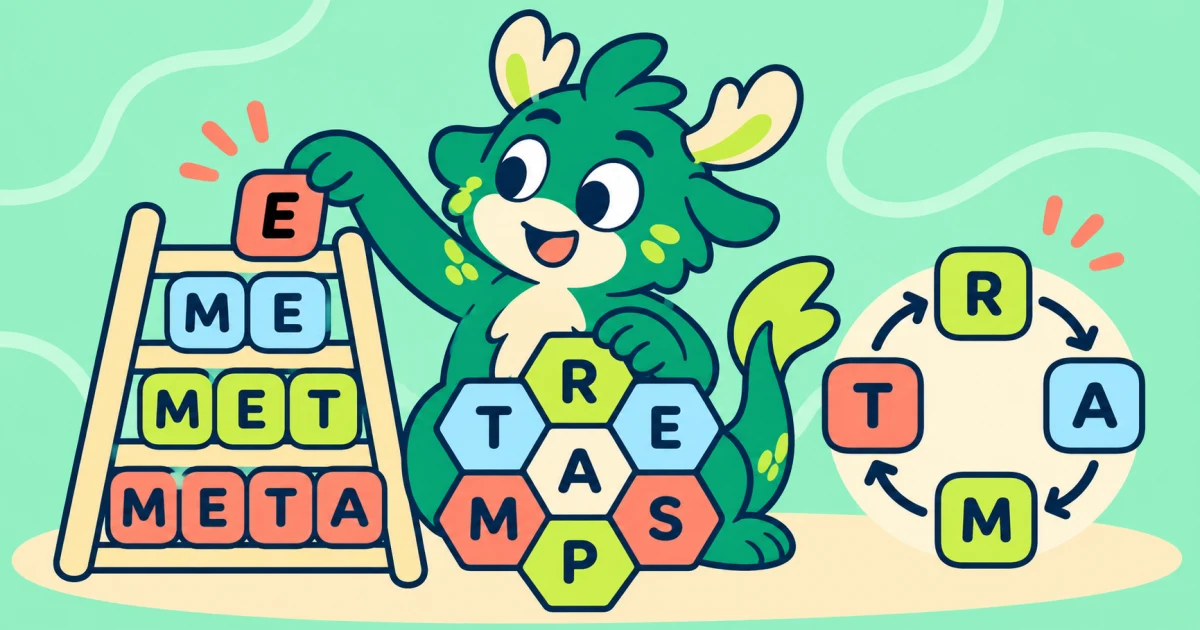
Endings
Test common endings only when the rack contains every required letter.
Pairs
Hold a promising consonant or vowel pair while rearranging the remainder.
Subtraction
Remove a candidate from the rack to expose missing or extra copies.
Find frames, not finished words
Look for common structural frames such as an opening consonant pair, a final E, or a familiar ending. With EILNST, the frame _ I _ _ E N may suggest LISTEN, while _ I _ E N T can lead toward SILENT. Frames let you place two or three letters with a reason, then test the remainder instead of restarting after every failed arrangement.
Do not lock a frame merely because it looks familiar. Write the unused letters next to it. If a frame leaves a remainder that cannot form a credible cluster, release it quickly. A useful frame reduces uncertainty. A decorative frame that strands letters is only another guess.
A worked LISTEN family
The letters EILNST produce LISTEN, SILENT, ENLIST, TINSEL, and INLETS in the reviewed Wordmap round. LISTEN and SILENT show that the same six letters can support different grammatical uses and different internal clusters. ENLIST begins with a productive EN sequence. TINSEL uses the same final EL found in many nouns, while INLETS uses the plural ending S.
A systematic pass might test S as an opening, then as an ending, then the likely pairs ST, SL, and NT. Each successful answer becomes evidence for another frame, but the inventory check remains final. Meaning does not establish an anagram. Exact letter equality does.
Handling repeated letters
Repeated letters should be written with counts, such as A2, E1, R1, rather than as a loose pile. When a candidate uses one A, reduce A2 to A1. This small notation prevents your eye from treating identical tiles as one resource. It is also useful in timed rounds because you can reject an impossible candidate before typing it.
Repeated letters can create multiple visual arrangements that spell the same word. Score unique words, not tile permutations. Wordmap's Anagram Sprint explains duplicates immediately and uses hand-checked answer families, so the score reflects the disclosed round rather than an undisclosed dictionary claim.
A repeatable sprint routine
Use three passes. In the first pass, capture the most obvious full-length word. In the second, move the first letter to the end and test new openings. In the third, inspect common beginnings and endings while subtracting the remainder. This is faster and more teachable than continuous visual shuffling.
After a round, compare missed answers by structure. Did you miss a plural, an opening such as EN, or a less familiar consonant pair? Choose one missed structure for the next session. The point is to build reusable recognition, not merely memorize one rack. Test the routine in Anagram Sprint, where the finite answer family is shown after play.
Measure improvement without chasing speed
Track three values: valid words found, invalid submissions, and the first time at which you stopped finding new structures. A faster round is not necessarily better if it produces many inventory errors. Aim first to reduce invalid submissions, then to find the same valid family with fewer abandoned frames.
For a useful comparison, repeat the method on a different rack of the same length rather than replaying the identical answers. This tests transfer instead of memory. Write the two structures that helped most, such as a plural ending or an opening consonant pair, and check whether they remain productive when the letters change.