
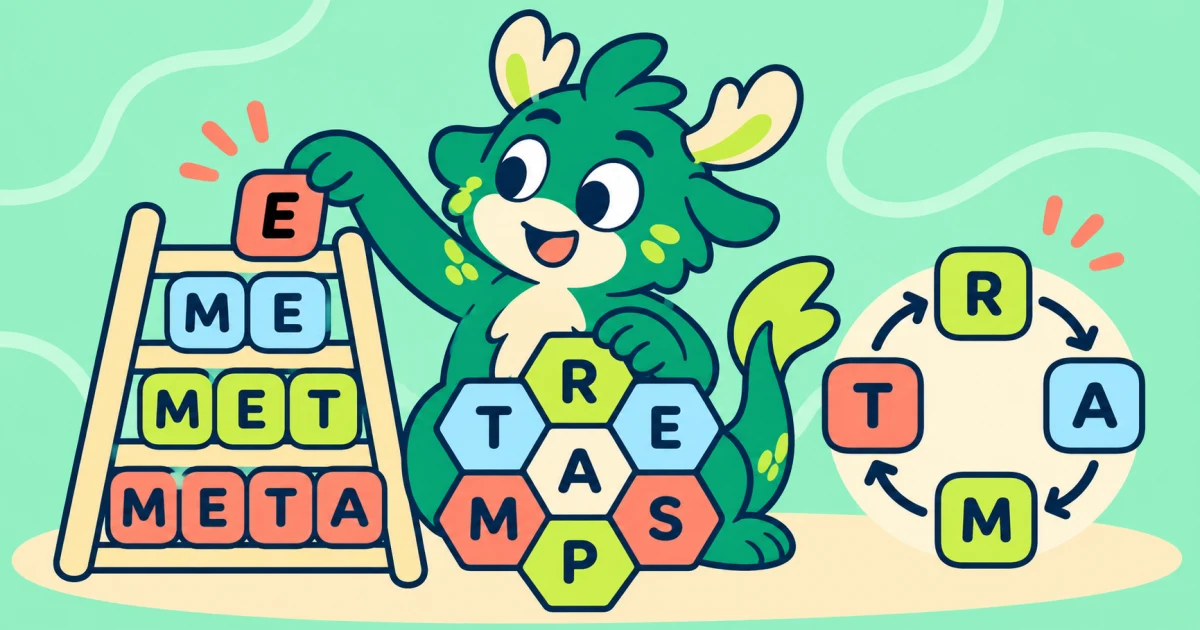
Read a pattern as a set of constraints
A word pattern records known positions, excluded positions, and letter quantities. It narrows candidates, but it does not identify meaning or guarantee one answer.
Fixed
C A _ E fixes three positions.
Excluded
A letter may be absent everywhere or only wrong in one position.
Counted
Repeated feedback sets a minimum or maximum quantity.
A pattern is a constraint, not a word
A pattern such as C A _ E has fixed positions and one open slot. It says nothing by itself about whether the result is common, accepted in a particular game, or appropriate to a clue. Keep those questions separate.
Positional evidence is strongest when paired with exclusions. C A _ E plus 'no R, S, or T' is a much smaller search space than the visible pattern alone.
Repeated letters change the search
A letter can be present more than once even when an earlier guess reveals it only once. Track minimum and maximum counts: one confirmed A establishes a minimum of one, while an extra grey A in the same guess may establish a maximum.
This count-based method prevents a common error: ruling out a repeated-letter answer because a board visually emphasizes position more than quantity.
Use frequency carefully
Letter frequency is a tie-breaker, not proof. Corpus choice matters: everyday prose, dictionaries, place names, and game answer lists have different distributions.
When two candidates fit, prefer the one that tests more unresolved letters if the aim is information. Prefer the more likely candidate only when the aim is to solve immediately.
Separate structure from similarity
Two words can share letters without sharing positions, and they can share positions without being close in meaning. Edit distance counts insertions, deletions, and substitutions needed to transform one string into another. Positional matches count only letters that occupy the same index. These measurements answer different questions.
For example, MAP and MOP have two positional matches and an edit distance of one. MAP and AMP use the same three letters but move them into different positions. An anagram measure would treat the second pair as closely related while a position puzzle would not. Name the measure before interpreting the result.
State the word-list boundary
A pattern tool needs a source list before it can propose candidates. A dictionary, a classroom list, and a game's reviewed answer set will not contain identical entries. Proper nouns, inflections, regional spellings, and abbreviations may be handled differently even when each source is internally consistent.
Wordmap's playable challenges use finite reviewed sets. A missing candidate therefore means it is outside that challenge set, not that the spelling can never be valid in English. This distinction prevents a technical filter from becoming an unsupported language claim.
Build a repeatable comparison
Normalize case and remove nonalphabetic characters before comparing structure. Then report length, letter counts, shared positions, and edit distance separately. If the words have different lengths, make clear that later positions are not directly aligned after an insertion or deletion.
Use the same method for every pair and preserve the input alongside the result. That small audit trail makes a comparison reproducible and helps a reader see whether the conclusion comes from the letters or from an editorial interpretation.