
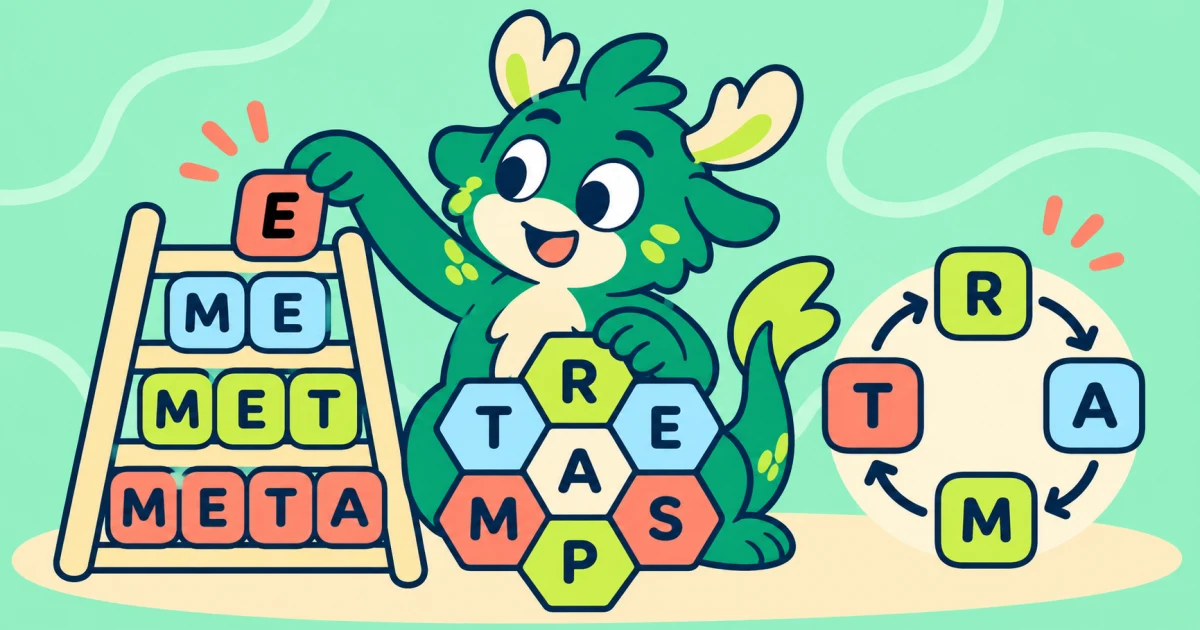
Plan one deliberate practice session
Unlimited Wordle practice becomes useful when each session tests one named decision, records the first weak guess, and stops before attention fades.
- Before
- Choose vowel placement, repeated letters, or candidate control.
- During
- Write what each color changes before entering the next word.
- After
- Replace one low-information guess and explain why the alternative is stronger.
Practice with a purpose
Unlimited rounds are useful only when each round tests an idea. Before the first guess, choose what you want to observe: vowel placement, common consonant pairs, repeated letters, or how quickly you stop using impossible positions.
Record the candidate set after each clue instead of chasing a streak. A round that exposes a weak elimination habit is more valuable than a lucky second-guess solve.
A compact review loop
After a round, write the answer pattern, the first point at which the solution became uniquely identifiable, and one guess that added little information. Replace that guess with a stronger alternative and compare the letters it would have tested.
For example, if the pattern is _ A _ E R and you already ruled out S, T, and P, guessing WATER retests known positions. A candidate such as MAKER may test a new consonant while respecting the evidence. The goal is not a universal best word. It is a better decision for the board in front of you.
What unlimited play cannot teach by itself
Fast repetition can hide the same mistake. It does not automatically teach word frequency, valid double-letter patterns, or when a clue leaves several equally plausible answers. Deliberate pauses and a written candidate list make those limits visible.
Our practice board accepts alphabetic five-letter guesses and explains each tile state. It does not claim to reproduce a publisher's private answer list, and it avoids presenting an arbitrary score as linguistic truth.
A review log measures decisions
- Mark the first turn where the evidence was not written down.
- Identify any guess that repeated a settled position without a reason.
- Write one alternative and the exact uncertainty it would test.
Keep a candidate notebook
Use one line per turn: record the visible pattern, excluded letters, confirmed minimum letter counts, and two or three candidates that still fit. If a later guess contradicts that line, identify whether the error came from position, quantity, or an unsupported assumption. This takes less than a minute and turns a vague miss into a specific correction.
The notebook is most useful when two answers remain. Write what one test word would reveal about both candidates before submitting it. A solve guess chooses one candidate; an information guess separates them. Neither choice is always correct, but stating the purpose makes the decision reviewable.
Measure decisions instead of speed
A useful practice summary counts avoidable repeats, guesses that violated known positions, and turns where the candidate set was not written down. These measures describe actions under your control. Completion time and streak length can be entertaining, but they are strongly affected by answer familiarity and luck.
Compare sessions only when the rules and review method are the same. A ten-round session with notes is not directly comparable with rapid play. Look for one repeated error across several rounds, then make that the next session's single focus.
Use a stopping rule
Stop after a planned number of rounds or when attention begins to replace evidence with guessing. Review the last difficult board while the reasoning is still fresh. Continuing indefinitely can inflate a streak while reducing the quality of each decision.
A practical closing routine is to save one informative pattern, one weak guess, and one alternative you would now choose. The next session begins with those three items, so unlimited access supports deliberate practice instead of endless repetition.