Word Building: Letters, Stems, and Transformations
Word building becomes easier to study when every move has a visible constraint. These guides connect the playable mechanics to repeatable methods you can inspect after a round.
Explore Word Building: Letters, Stems, and Transformations
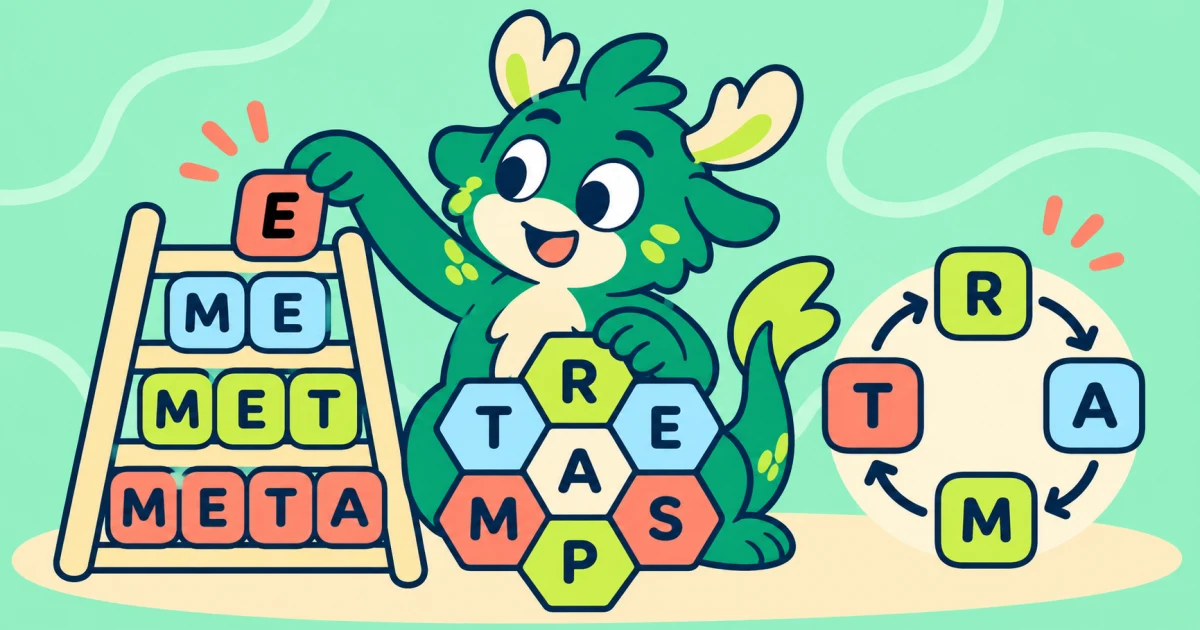
An anagram treats letters as a fixed inventory. A word ladder preserves positions except for one change. Letter Hive limits letter types but allows reuse. Prefix and Suffix Builder asks what each piece contributes to meaning. These games may share letters while requiring different mental models. Before playing, write the non-negotiable rule in one line: exact inventory, one changed position, required center letter, or meaningful affix. That line decides which candidate moves are legal before vocabulary preference matters.
Make review visible
After a round, record the first constraint you overlooked, the word family that opened the puzzle, and one alternative move. This short review turns play into reusable pattern knowledge without pretending that one score measures vocabulary. For example, after missing COLD to CORD in a ladder, note whether you overlooked the R bridge or changed more than one position. In an anagram, preserve a letter tally so the review can expose one omitted or duplicated tile.
Where Wordmap draws the boundary
Accepted lists are finite and reviewed for each mechanic. A rejected entry means it does not satisfy this challenge as implemented. It is not a declaration that the entry can never be valid English. Use a dictionary to investigate language outside the game, but do not silently add that finding to the challenge bank. Separating lexical research from puzzle validation keeps both claims accurate and makes rejected entries easier to report.
A useful session order
Begin with a slow ladder or word-parts puzzle where every decision can be inspected. Move to an anagram or hive only after choosing one pattern to practice. Finish by reviewing missed structures instead of extending play until attention drops. A focused twenty-minute session might use one ladder, one anagram, and five minutes of written review. Carry a single observation between mechanics, such as checking repeated letters, instead of trying to improve every skill at once.
Compare mechanics carefully
A high score in one mechanic does not transfer automatically to another. Inventory accuracy, positional planning, morphological knowledge, and rapid recall are different tasks. Compare your own decisions within the same rules before comparing totals across games. Track evidence appropriate to the task: legal steps for ladders, unused tiles for anagrams, center-letter positions for hives, and meaning changes for affixes. A shared points scale would hide those differences rather than clarify them.
What makes these pages original
Every guide uses a worked puzzle from Wordmap's reviewed data, identifies the exact constraint that drives the mechanic, and gives a repeatable review method. The pages are not title-swapped summaries of one generic strategy. The linked field notes disclose the example, rule, limitation, and next action for each mechanic. Compare their reasoning paths, then open the playable round that tests the exact constraint you want to practise.