
Plan the bridge, not only the next rung
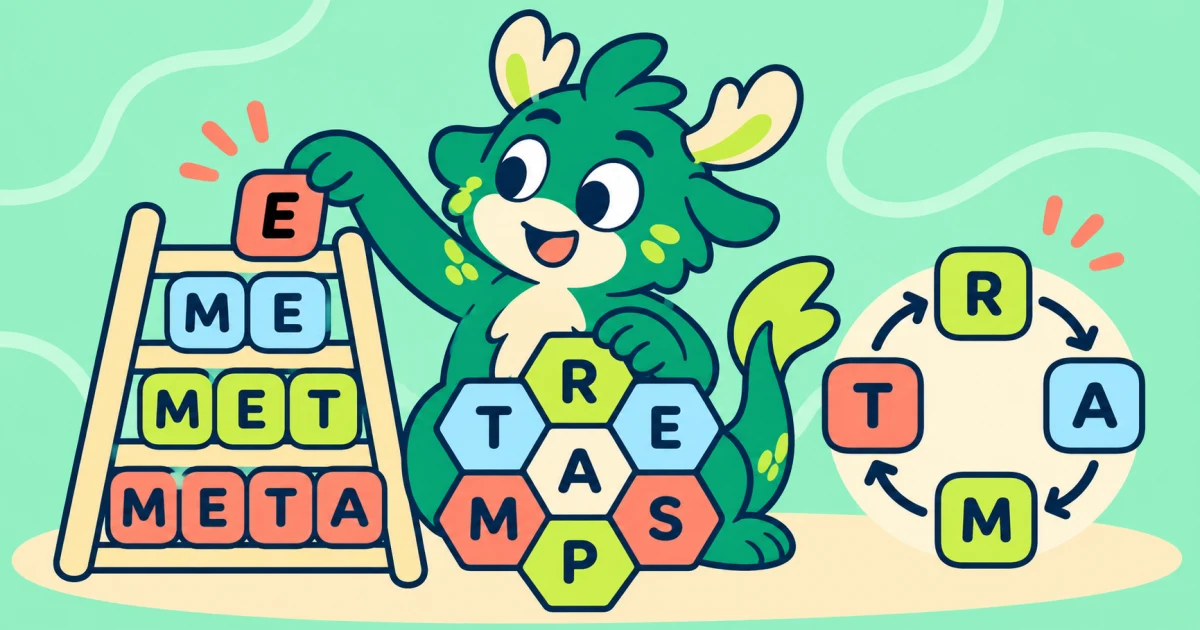
Word Ladder strategy improves when you compare both endpoints, protect fixed positions, and choose bridge words with several legal exits.
The direct method
A word ladder changes one letter at a time while preserving word length and every untouched position. Start by writing the source and target on separate lines. Mark the positions that already agree, then list the positions that must change. This turns a vague vocabulary search into a small position problem. If COLD must become WARM, every position eventually changes, but that does not mean the positions should change in order.
Before entering a move, ask two questions. Does the candidate differ from the current word in exactly one position, and does it leave a credible route toward the target? A legal move can still be strategically poor when it leads to a spelling neighborhood with few exits. The best move often increases your future choices even when it does not immediately resemble the target.
A worked COLD to WARM ladder
One clean route is COLD, CORD, CARD, WARD, WARM. COLD to CORD changes L to R. CORD to CARD changes O to A. CARD to WARD changes C to W. WARD to WARM changes D to M. Every move changes exactly one letter, and the intermediate words progressively establish the ending and vowel pattern needed by WARM.
Notice that the first move does not copy the target's first letter. Forcing W too early would require a common word shaped W O L D, which is not available in the reviewed puzzle set. The route instead builds the useful ending RD, then changes the vowel, then the first and final letters. The middle of the ladder does the structural work.
Forward search
List legal neighbors of the start that open common letter patterns.
Backward search
List words one move from the target, then look for a shared middle neighborhood.
Use both ends of the puzzle
When the forward search stalls, reverse the problem. List words one move away from the target, then look for a connection to your forward candidates. For WARM, useful neighbors include WARD, WORM, and WARE. For COLD, useful neighbors include CORD, GOLD, and MOLD. The shared bridge becomes easier to see when both neighborhoods are visible.
This bidirectional method is especially useful when a target has an uncommon ending. It prevents you from spending moves in a large, comfortable family that never reaches the target family. You are not guessing the whole route at once. You are trying to make the two search frontiers meet.
Repeated letters and narrow neighborhoods
Repeated letters create extra care because changing either copy can produce very different neighborhoods. Label positions, not just letters. In a word such as FALL, the L in position three and the L in position four are separate constraints. A candidate must preserve the correct untouched position even when the visible letters look interchangeable.
Short common words can also have surprisingly narrow legal neighborhoods inside a curated game. Wordmap therefore describes its accepted set as a reviewed challenge list, not a complete English dictionary. If a familiar word is rejected, that means it is outside this puzzle set. It does not make a universal claim about English.
Ten-minute ladder routine
- Mark positions that already match the target.
- Build two moves from each endpoint.
- Circle a bridge with more than one continuation.
- After solving, identify the first rung that created a dead end.
A ten-minute practice routine
Play one ladder without a timer. After every move, write the number of target positions now matched and at least two possible next words. If you can name only one next word, mark the move as fragile. Finish the route, then replay from the start and replace the first fragile move with a candidate that creates more branches.
Use move count as feedback, not as a verdict on vocabulary. A longer valid ladder may reveal a useful bridge family that a lucky short solve would hide. The practice goal is to recognize neighborhoods, plan from both ends, and explain why each move preserves a route. Apply the method directly in the Wordmap Word Ladder game.
Diagnose a failed route
When a route reaches a dead end, keep the full sequence instead of erasing it. Circle the first move after which every candidate leads away from the target neighborhood. That is the decision worth reviewing. The last word in the route is only where the earlier weakness became visible.
Compare the failed move with one successful bridge. Count how many legal exits each offers inside the reviewed set and which target positions those exits can change. This simple branch comparison produces original evidence from the puzzle in front of you. It is more useful than memorizing a universal opening move, because another source and target pair will create different neighborhoods.