
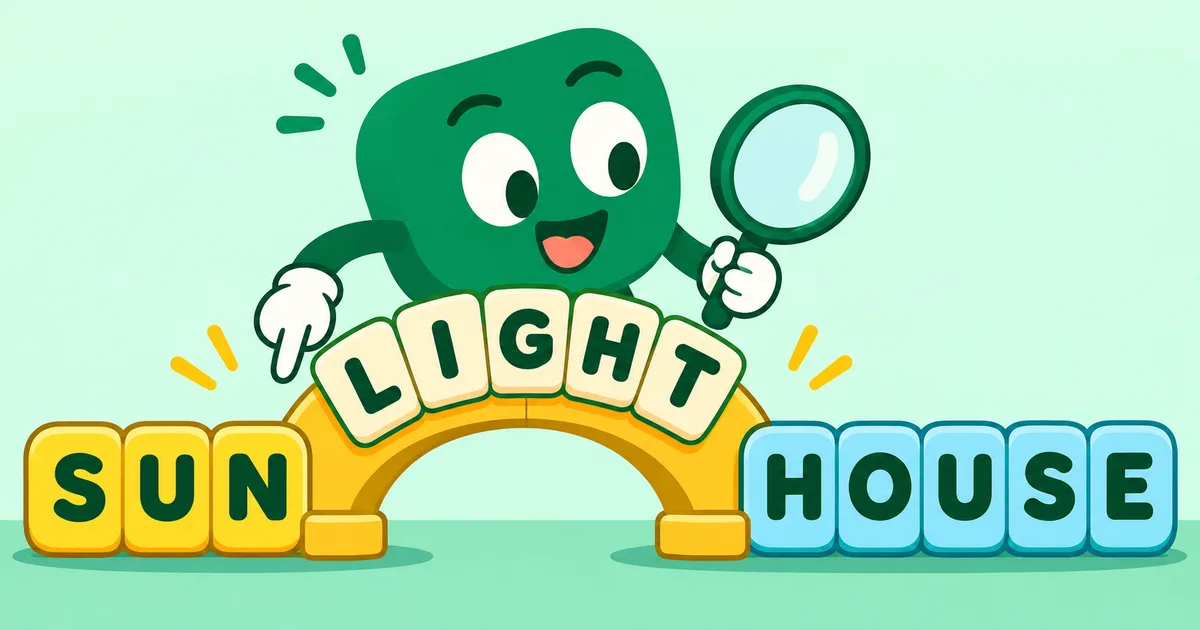
One bridge must create two familiar expressions
Compound Word strategy requires a candidate to pass on both sides. A strong first pairing is not enough when the second expression fails.
SUNLIGHT and LIGHTHOUSE provide the two independent checks.
A bridge answer needs two proofs
A compound bridge shows one word on each side of a blank. Your answer must make a familiar expression with the left word and another familiar expression with the right word. SUN, blank, HOUSE has the answer LIGHT because SUNLIGHT and LIGHTHOUSE both work. Finding only SUNLIGHT is half a solution, not a completed bridge.
Write the two proposed results before submitting. This small step exposes an answer that feels related to the theme but fails on one side. The Wordmap game reveals both completed expressions after a correct answer so the relationship stays visible and can be checked.
Left test
Write the left word followed by the candidate and check the exact expression.
Right test
Move the same candidate before the right word without changing its form.
Let the weaker side do more work
One side is often easier. STAR quickly suggests FISH, but the candidate must also produce FISHCAKE on the other side. Once a familiar first expression appears, move attention to the less certain half. Ask whether that exact word order is established English rather than merely understandable.
If several words complete the first side, list them without committing. Test each candidate against the second side and cross out the failures. This is controlled elimination. It is more reliable than repeatedly reading the whole prompt and waiting for one answer to feel right.
Check order, spacing, and form
Compounds can be written as one word, two words, or a hyphenated form. Wordmap's current challenge uses reviewed familiar expressions and displays the intended result. A solver should preserve the displayed word order because BALLROOM and ROOM BALL do not make the same claim, even though both words are present.
Do not invent a spelling rule from one puzzle. NEWSPAPER is closed, while PAPER BAG is open. The bridge mechanic tests whether both expressions are established in the reviewed set. It does not claim that every English compound follows one spacing pattern.
A three-column bridge ledger
| Candidate | Left result | Right result |
|---|---|---|
| PAPER | NEWSPAPER | PAPER BAG |
| ROOM | Newsroom | Room bag does not pass |
Work through a candidate ledger
For NEWS, blank, BAG, begin with candidates that commonly follow NEWS. PAPER creates NEWSPAPER. Move the same candidate before BAG and check PAPER BAG. Both pass. A candidate such as ROOM might create a phrase in one context but does not satisfy both reviewed expressions, so it leaves the ledger.
Use three columns labeled candidate, left result, and right result. Mark each result as familiar, doubtful, or failed. Submit only when both results are familiar and the spelling matches the challenge. The ledger is especially helpful when a broad word such as HOME, BOOK, or LIGHT participates in many combinations.
Distinguish compounds from loose associations
Two words can be associated without forming a compound. Snow and winter share a topic, but that relationship does not automatically create a bridge answer. The test is linguistic: does the completed pair function as a recognized expression in the intended order? A thematic connection alone is too weak.
This boundary makes the game useful for vocabulary. It asks how whole words combine into a conventional unit, while the Prefix and Suffix Builder asks how meaningful parts attach inside one word. Compare the two mechanics instead of treating every joined form as the same process.
Review families after the answer
After solving, keep the bridge word and find two more reviewed compounds that use it in different positions. BALL can appear after SNOW and FOOT, then before ROOM and COURT. Label which combinations are closed and which are open. Stop when the expression becomes doubtful and verify it in an appropriate dictionary before teaching it as standard.
A useful session record contains the bridge, both game expressions, one additional verified example, and the wrong candidate that came closest. This records what made the answer work. It provides more learning value than memorizing the finished pair or counting speed alone.