
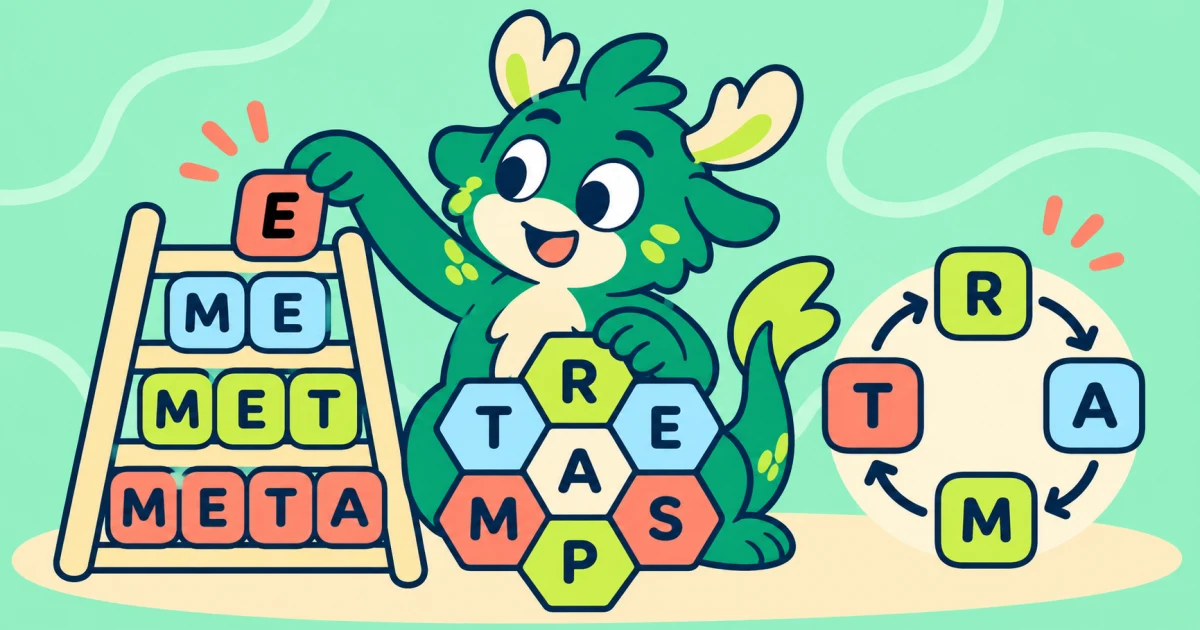
Give every connection a name
A useful word map separates spelling, sound, morphology, meaning, and topic. A line without a relationship label invites the reader to infer a claim the map may not support.
Anagram
Same letter inventory, different order.
Derivation
A related form built from the same base.
Meaning
A sense relationship that needs context or a lexical source.
Name the relationship
Two words may share letters, a root, a sound, a grammatical role, or a topic. A useful map labels the edge instead of drawing a line that leaves the relationship unexplained.
For example, 'act' connects to 'action' by derivation, to 'perform' by meaning, and to 'cat' by letter rearrangement. Those are three different kinds of evidence.
Keep automatic claims modest
Software can reliably calculate letter overlap, position matches, n-grams, and edit distance. Meaning requires lexical data and context; visual similarity is not semantic similarity.
Our Word Pattern Explorer therefore reports structural facts and leaves semantic claims out unless they are backed by a named source.
Design for a question
A classroom map, crossword aid, and writing thesaurus need different connections. Begin with the task, then choose only the relationships that help answer it.
More nodes do not automatically create more insight. A small map with explicit edges is often easier to verify and reuse.
Use an edge legend
Give every relationship type a name and one visual treatment. Derivation, synonymy, sound, shared spelling, and topic membership should not look interchangeable. A legend allows a reader to follow one kind of connection without assuming that every nearby node has the same relationship.
Direction matters for some edges. ACT can produce ACTION by derivation, but that does not make ACTION the root of ACT. Other relationships, such as anagram structure, can be shown as nondirectional. The map should reflect the claim it actually makes.
Start with a small, auditable map
- Choose one central word and one user question.
- Add no more than two checked examples for each relationship type.
- Write the relationship on every edge.
- Remove any connection that cannot be explained in one sentence.
Build one small map first
Start with a central word and add no more than two verified examples for each relationship. For ACT, a structural branch might include CAT as an anagram, a morphological branch might include ACTION, and a meaning branch might include PERFORM when a named lexical source supports the sense.
Review each edge independently. If the connection cannot be stated in one sentence, it may be too vague for the current map. Removing an uncertain line usually improves the map more than adding several weak associations.
Match the map to its user
A learner may need definitions and example sentences, a puzzle solver may need letter patterns, and a writer may need usage distinctions. The same central word can support separate views, but combining every view at once creates visual density without a clear task.
Finish with a verification checklist: every node is defined, every edge is labeled, computed relationships can be reproduced, semantic claims have a source, and the map answers the opening question. That checklist makes the artifact teachable and correctable.