
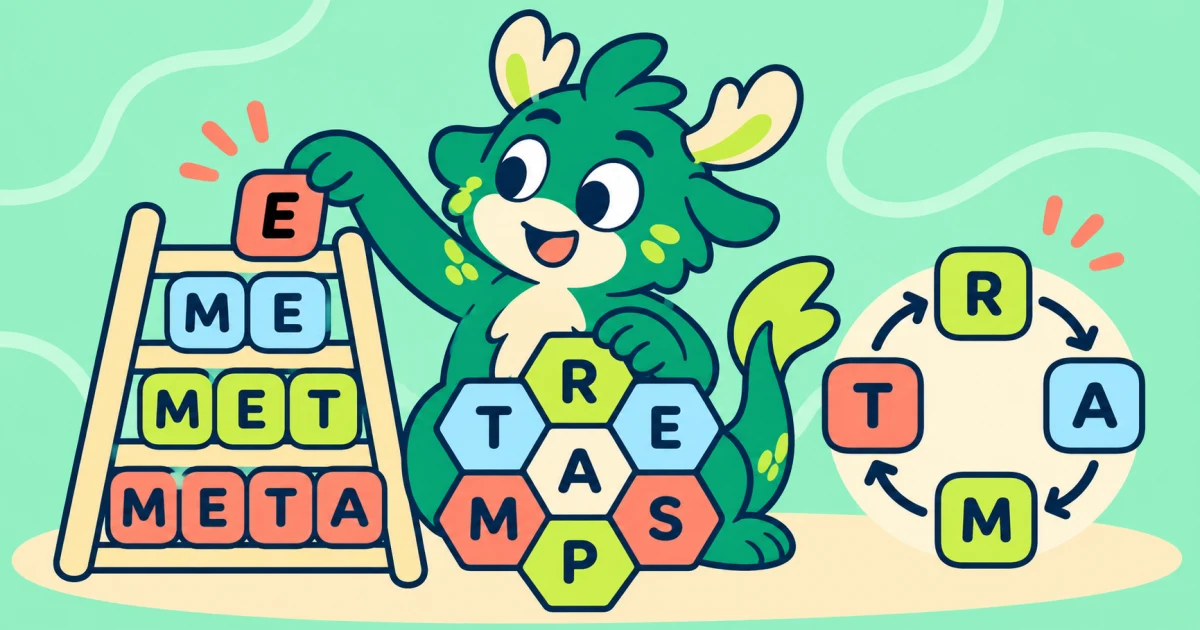
Make the center letter your anchor
Letter Hive strategy treats the required center as a fixed constraint, then expands reliable stems and affixes instead of scanning the rack at random.
Turn one rack into smaller searches
A Letter Hive round allows only the displayed letters and requires the center letter in every answer. That center rule is an advantage because it divides the search. Place the required letter at the beginning, inside, and near the end of a blank frame. Then test the surrounding letters in each position rather than scanning the entire rack at once.
For the rack A E L P R S T with P required, begin with P___, _P__, and ___P. The first frame suggests PALE, PAPER, PEAR, PEST, and PART. The internal frame can reveal LEAP and SPARE. Every branch stays attached to the actual rule, so you spend less time imagining words that cannot qualify.
Stem
Begin with a short form that already contains the center.
Extend
Test a prefix, suffix, or repeated allowed letter.
Verify
Check the puzzle's finite acceptance rule before counting the word.
Use stems as small engines
A stem is a useful partial structure, not necessarily a linguistic root. From PA, you can test PALE, PAST, PART, and PAPER. From PE, you can test PEAR and PEST. From _AP_, you can see LEAP and TAPE by changing the outer positions. Each accepted word suggests a nearby pattern that may reuse most of its letters.
Do not assume that every extension is accepted. The game's reviewed list is finite, and length or inflection rules may differ between games. A stem is a search aid. Validation still belongs to the displayed challenge set.
Track coverage, not only score
Make a seven-letter checklist and mark which letters you have used with the center. If R has appeared only in PEAR, try moving it earlier or later. This coverage view exposes neglected letter relationships. It also gives you a clear next action when the obvious word family is exhausted.
Length coverage is useful too. If you have several four-letter answers but no five-letter answer, try extending an accepted four-letter stem by one displayed letter. Longer is not automatically better for language learning, but it changes the structure you are asking your memory to retrieve.
Keep a coverage sheet
- Short forms
- Record the reliable three- and four-letter stems.
- Long forms
- Mark extensions that reuse those stems.
- Unused pairs
- Note letter combinations you have not tested yet.
When letters may repeat
In Wordmap's Letter Hive, displayed letters may repeat inside an answer. A single P tile can support PAPER because the rack represents allowed letter types, not physical tile quantities. State this rule before play because many anagram games use the opposite rule. Confusing the two mechanics creates false rejections and wasted search.
Once repetition is allowed, test doubled vowels and repeated center letters deliberately. Still verify that every distinct letter belongs to the rack. Repetition relaxes quantity, not membership.
An honest stopping rule
A useful session ends when you have tested the center letter in several positions, extended the main stems, and inspected neglected letters. Endless staring rarely adds much after the search has become unstructured. Reveal the reviewed list, classify what you missed, and carry one pattern into the next round.
Missed words can be grouped by opening, ending, center position, or unfamiliarity. That review gives the score an explanation. Play the current Letter Hive round, then compare your path with the disclosed accepted list rather than treating the number alone as a measure of vocabulary.
Design a personal coverage sheet
Draw three columns labeled opening, middle, and ending. Add each accepted word according to the position of the required letter. Then mark the word lengths you reached and the outer letters you never paired with the center. The sheet reveals search habits that a single total cannot show.
On the next round, spend the first minute in your weakest column. If most prior answers began with the center, search for internal and final positions before returning to familiar openings. This is a controlled practice change with a visible reason. It does not require a larger dictionary, a streak, or a claim that one pattern is objectively best.