Pattern Puzzles: Grids, Codes, and Crossings
Pattern puzzles reward vocabulary, but their strongest evidence often comes from geometry or symbol consistency. Start with the rule system, then let language fill the remaining space.
Rules before recall
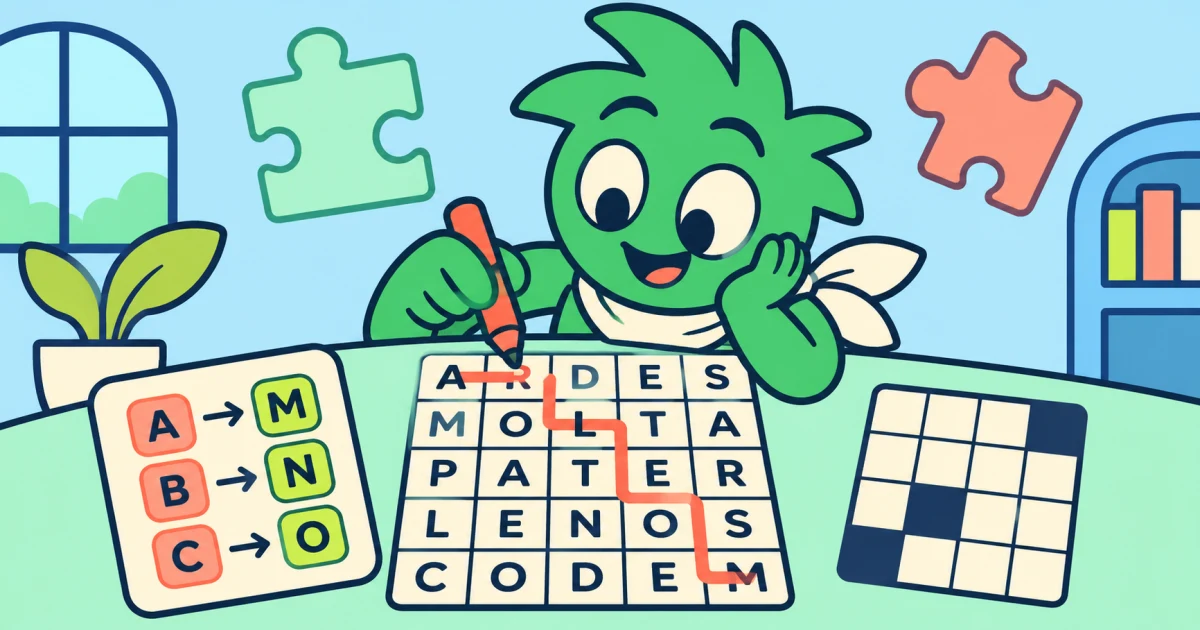
A grid defines legal movement, a substitution puzzle defines a stable key, and a crossword defines intersecting slots. Read those constraints before searching memory. A familiar word is not useful when the path, mapping, or length makes it impossible. On a grid, point to every cell in order; in a cipher, write the forward and reverse key; in a crossword, record length and crossings. These small external records prevent a plausible word from bypassing the actual structure.
Use contradictions productively
A failed hypothesis should reduce the search. Record the mapping, crossing, or path that caused the conflict and keep the unaffected evidence. This prevents repeated guessing and makes the solve explainable. If a cipher guess assigns one answer letter twice, remove the new hypothesis while preserving earlier confirmed mappings. If a grid path jumps a cell, keep the word idea but reject that route. A contradiction tells you exactly which claim failed.
Review the first missed transition
When an answer is revealed, find the earliest transition you did not see: a diagonal move, a repeated pattern, a grammatical form, or a crossing letter. That diagnosis transfers better than memorizing the final answer. Classify the missed transition before replaying: diagonal adjacency, reused tile, repeated symbol, answer form, or uncertain crossing. The category gives the next round one observable practice goal instead of a vague instruction to look harder.
Change one search dimension
When you stall, change direction, word length, anchor, or confidence level. Do not change every tactic at once. A controlled reset helps you see whether geometry, vocabulary, or an earlier assumption is actually blocking the solve. A stalled grid can be rescanned from corners, while a stalled crossword can be reordered by confidence. A cipher may need a repeated pattern rather than another frequency guess. Select the reset that belongs to the visible obstacle.
Keep tentative evidence tentative
A proposed cipher mapping or crossword answer should remain removable until another part of the puzzle supports it. Marking confidence prevents one attractive guess from hardening into several downstream errors. Use pencil marks, removable interface states, or a three-level confidence label. Confirm a claim only when another part of the puzzle supports it. This keeps one early guess from becoming several apparently independent errors.
Choose the next playable test
Use Word Grid for adjacency, Cryptogram for mapping consistency, Mini Crossword for crossing evidence, and Missing Vowels for consonant structure. Each game isolates a different type of pattern rather than repeating one board under several names. Begin with the mechanic that isolates your question. Adjacency belongs in Word Grid, symbol consistency in Cryptogram, intersection evidence in Mini Crossword, and consonant reconstruction in Missing Vowels. Review the disclosed answer path before switching games.
