
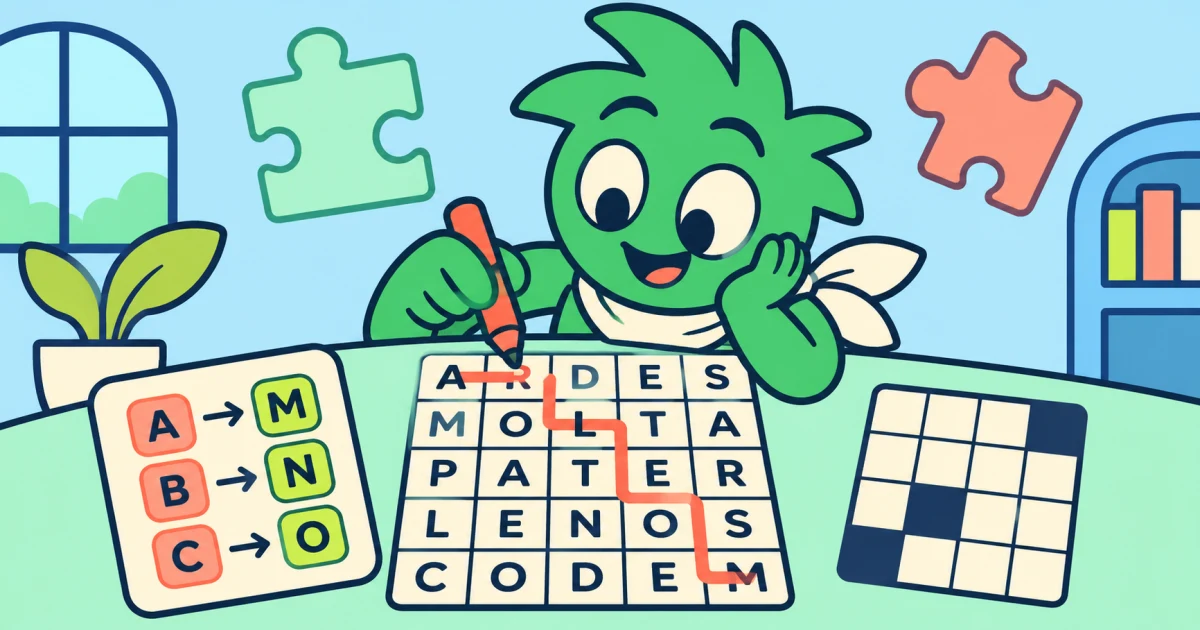
Separate vocabulary from board geometry
Word Grid scanning works when a player first confirms the legal movement rule, then traces one continuous path without reusing a tile illegally.
Know the geometry first
An adjacent-letter grid is a path puzzle as much as a vocabulary puzzle. In Wordmap, horizontal, vertical, and diagonal neighbors count, a tile cannot be reused in the same word, and the board does not wrap across an edge. Read those rules before searching because a word that appears visually close may still require an illegal jump.
Treat each tile as having a neighborhood. Corner tiles have three neighbors, edge tiles usually have five, and interior tiles can have eight. Interior anchors offer more branching, while corners can be easier to inspect completely. Neither is universally better. The board decides.
Start from distinctive anchors
Rare letters, repeated letter pairs, and common endings make better anchors than an ordinary vowel in the center. If the board contains one B, inspect paths beginning or ending at B. If you see I next to N and G, test whether a legal route can complete a familiar ending. This narrows the board without assuming every visible fragment belongs to a target.
Run separate scans for openings and endings. A cluster may be hard to recognize left to right but obvious when treated as the final letters of a word. Since paths can turn, the visual direction of reading is not the same as spelling order.
Change the scan, not just the word list
- Start from an uncommon letter or pair.
- Trace outward clockwise, then reverse direction.
- Switch from long candidates to short stems when attention stalls.
- Reset from a different corner before repeating the same visual route.
Trace before you tap
For each candidate, point to the tiles in spelling order and check adjacency one transition at a time. Mark the used tile mentally or with the game's selection state. A path such as C to A to T can be legal even when it bends, while a straight-looking word may fail because its middle tiles are separated by one cell.
If a candidate requires the same tile twice, search for a second copy before rejecting it. Repeated letters need repeated tiles in this mechanic. This differs from Letter Hive, where displayed letter types may repeat. The rule belongs to the game, not to the word itself.
Change the search when you stall
After one minute, switch one variable. Search only three-letter words, then four-letter words. Search from corners, then from the center. Search clockwise around an anchor, then counterclockwise. A deliberate reset prevents your eyes from replaying the same paths while giving you the feeling of scanning the whole board.
You can also review unused regions. If every found word occupies the upper half, spend one pass on the lower half. This does not guarantee a target there, but it corrects attention bias and makes your coverage auditable.
Review paths, not just answers
When the round reveals missed words, trace each one on the board. Label the first transition you failed to notice: diagonal, backward, corner turn, or repeated letter. That label is more useful than memorizing the answer because it describes a visual habit you can test on the next board.
Wordmap checks every listed target against the board during authoring, so each disclosed answer has at least one legal path. The target set is finite and reviewed. Use it to practice scanning and path verification, not as a claim that every possible English word on the grid has been catalogued.
Build a path notation
For detailed review, label rows A through D and columns one through four. A path can then be written as A1, B2, B3, C4. The notation makes illegal jumps and repeated cells obvious, and it lets two players discuss the same board without relying on gestures or a screenshot.
Use notation only after the round, when it clarifies an error. Writing every coordinate during timed play can replace visual practice with paperwork. The purpose is to preserve one difficult path, compare it with the board rules, and identify whether adjacency, direction, or tile reuse caused the miss.