
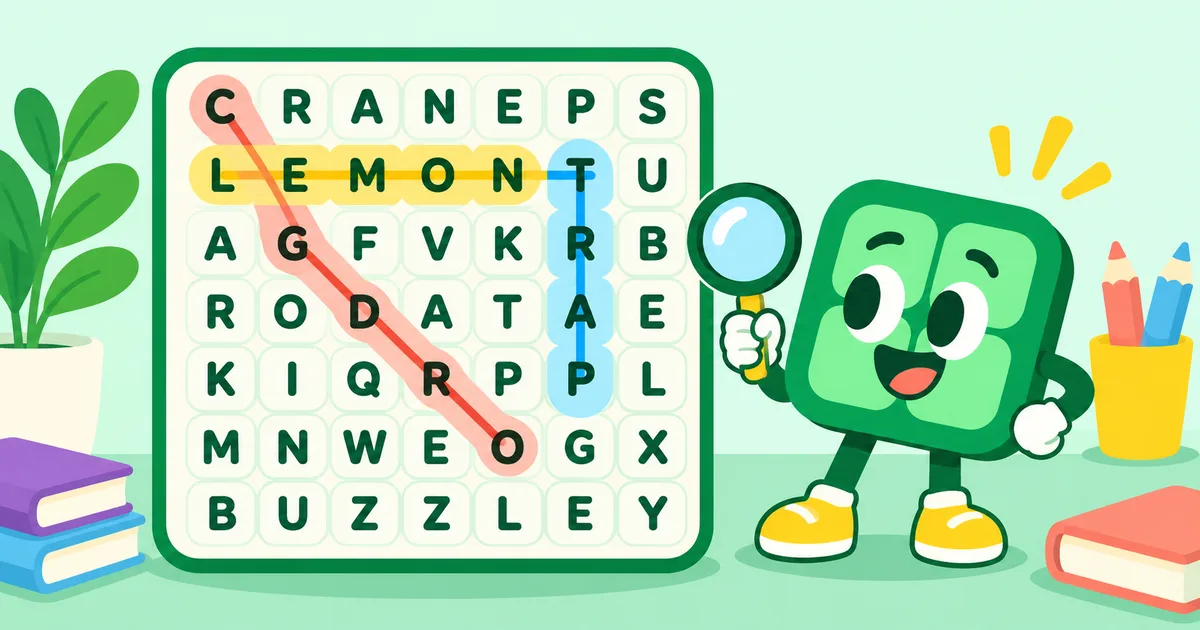
A valid word stays on one straight line
Word Search strategy uses distinctive endpoints, fixed directions, and complete line checks. A path that turns belongs to a different game mechanic.
Know the geometry before searching
A Wordmap word-search answer occupies one straight horizontal, vertical, or diagonal line. It may read forward or backward, but it cannot turn a corner. This differs from Word Grid, where a legal path can bend through adjacent cells. A familiar word is not a valid find until its endpoints define the correct straight line.
Read the target list and board size before beginning. The visible list makes the task visual scanning rather than hidden-theme guessing. It also gives each search a fixed first and final letter that can be checked against candidate endpoints.
Start with the rarer endpoint
Choose a target with an uncommon opening or ending letter. If the word is GLOBE and the board contains one G but several E tiles, start from G. Inspect the eight possible directions from that cell and stop a direction as soon as its next letter conflicts.
When the final letter is rarer, scan backward from that endpoint instead. The game accepts both reading directions. This method reduces the number of lines inspected while keeping the reasoning tied to visible letters rather than intuition.
Search GLOBE from its rarer endpoint
- Find each G on the board.
- Inspect the allowed straight directions from that cell.
- Stop a direction when the next letter is not L.
- Trace all five cells before selecting the endpoints.
Use a direction ledger
Divide the scan into horizontal, vertical, descending diagonal, and rising diagonal passes. Mark a direction after completing it for one target length. This prevents the eyes from drifting back to the same easy rows while untouched diagonals remain unchecked.
You do not need to draw on the board. A small note such as MAP: H, V, D records which direction families have been inspected. If attention fades, switch to a different target length or take a short pause rather than repeating an unstructured sweep.
Direction ledger
Horizontal
Rows checked in both reading directions.
Vertical
Columns checked from top and bottom.
Descending
Diagonals moving down the board.
Rising
Diagonals moving up the board.
Verify every cell between the endpoints
After spotting the beginning and end, trace the line one cell at a time. The row and column change must remain constant. A horizontal word changes column only, a vertical word changes row only, and a diagonal changes both by one at each step. Any turn or skipped cell invalidates the selection.
Overlapping words are allowed when the board contains them, so a previously found cell can belong to another answer. The no-reuse rule from Word Grid does not transfer here. Each mechanic states its own geometry and should be reviewed on that basis.
Handle backwards and overlapping answers
If a target does not appear forward, reverse its letter sequence and repeat the endpoint scan. Do not treat backward placement as a trick outside the rule. It is one of the disclosed directions and can be searched systematically like any other line.
An overlap is easier to inspect after one word is highlighted. Check whether its distinctive letters can anchor another target in a different direction. Still trace the complete second line. Sharing one or two cells does not prove that the remaining letters are present in order.
Review coverage instead of speed alone
After the round, note which direction contained the last word you found. If rising diagonals are consistently missed, begin the next board with that pass. If long targets are easy but short ones disappear into filler, search by distinctive letter pairs rather than length.
A useful record contains the target, its two endpoints, its direction, and the scan method that revealed it. This explains progress without claiming that a faster time measures complete reading ability. The themed grid is a focused visual-pattern activity with a finite disclosed answer list.